

Random Forest Regressor#
A Random Forest Regressor (RFR) is an ensemble learning method that combines multiple Decision Trees to perform regression (predict continuous values).
Instead of relying on a single decision tree (which may overfit), RFR aggregates predictions from multiple trees to improve accuracy and generalization.
It uses bagging (bootstrap aggregation) and random feature selection to create diversity among trees.
Key Idea:
“Many weak trees working together produce a strong, stable prediction.”
2. How It Works (Intuition)#
Bootstrap Sampling:
Randomly select samples from the training data with replacement to train each tree.
Each tree sees a slightly different dataset.
Random Feature Selection:
At each split in a tree, a random subset of features is considered.
This introduces more diversity among trees and reduces correlation.
Tree Training:
Each tree is grown independently and can be deep (can overfit its sample).
Prediction Aggregation:
Regression: The final prediction is the average of predictions from all trees.
This reduces variance and improves generalization.
3. Advantages of Random Forest Regressor#
Advantage |
Explanation |
|---|---|
Reduces overfitting |
Averaging multiple trees smooths out noise and variance from single trees. |
Handles nonlinearity |
Trees naturally capture nonlinear relationships. |
Robust to outliers & noise |
Ensemble averaging reduces impact of extreme values. |
Minimal assumptions |
No linearity or normality required. |
Feature importance |
Can rank features by their contribution to reducing error. |
4. Key Hyperparameters#
Parameter |
Description |
Effect |
|---|---|---|
|
Number of trees |
More trees → lower variance, slower computation |
|
Maximum depth of each tree |
Limits overfitting; deeper trees → more complex model |
|
Min samples to split a node |
Higher → simpler tree → reduces overfitting |
|
Min samples in a leaf |
Larger → smoother predictions → reduces overfitting |
|
Max features to consider at each split |
Lower → more randomness → reduces correlation among trees |
|
Whether to use bootstrap samples |
Usually True; False → full dataset per tree, can overfit |
5. Cost Function#
Each tree in a Random Forest Regressor uses a splitting criterion to decide the best splits:
Variance Reduction (Squared Error): Default criterion
Absolute Error (L1): More robust to outliers
Trees are trained independently; the ensemble reduces overall error.
6. Example Use Cases#
Predicting house prices
Forecasting sales, stock prices
Estimating medical measurements (e.g., blood pressure)
Any regression problem with nonlinear patterns and mixed feature types
7. Strengths vs Weaknesses#
Strength |
Weakness |
|---|---|
High accuracy & robust |
Harder to interpret than a single tree |
Handles nonlinear & mixed data |
More memory and computation needed |
Reduces overfitting |
Predictions are less smooth if trees are small |
Feature importance available |
Cannot extrapolate beyond observed values |
8. Summary Intuition#
Each tree → “opinion” about the target value.
Random Forest → “wisdom of the crowd” → averages all opinions.
Outperforms a single tree because it reduces variance without increasing bias too much.
# Step 1: Import Libraries
import numpy as np
import matplotlib.pyplot as plt
from sklearn.ensemble import RandomForestRegressor
from sklearn.model_selection import train_test_split
from sklearn.metrics import r2_score, mean_squared_error

# Step 2: Create Sample Regression Dataset
np.random.seed(42)
X = np.sort(np.random.rand(100, 1) * 10, axis=0)
y = np.sin(X).ravel() + np.random.normal(0, 0.3, X.shape[0])

# Split into training and test sets
X_train, X_test, y_train, y_test = train_test_split(X, y, test_size=0.3, random_state=42)

# Step 3: Initialize Random Forest Regressor
rf = RandomForestRegressor(
    n_estimators=100,      # number of trees
    max_depth=None,        # no max depth
    min_samples_split=2,   # minimum samples to split
    min_samples_leaf=1,    # minimum samples per leaf
    max_features=100,   # features considered at each split
    random_state=42,
    oob_score=True          # enable out-of-bag evaluation
)

# Step 4: Train the model
rf.fit(X_train, y_train)

# Step 5: Predictions
y_train_pred = rf.predict(X_train)
y_test_pred = rf.predict(X_test)

# Step 6: Evaluate Model
def evaluate(y_true, y_pred, label=""):
    rmse = np.sqrt(mean_squared_error(y_true, y_pred))
    r2 = r2_score(y_true, y_pred)
    print(f"{label} -> R²: {r2:.2f}, RMSE: {rmse:.2f}")

evaluate(y_train, y_train_pred, "Train")
evaluate(y_test, y_test_pred, "Test")
print("OOB Score:", rf.oob_score_)

# Step 7: Visualization
X_plot = np.linspace(0, 10, 200).reshape(-1, 1)
y_plot = rf.predict(X_plot)

plt.scatter(X_train, y_train, color='blue', label='Train Data')
plt.scatter(X_test, y_test, color='green', label='Test Data')
plt.plot(X_plot, y_plot, color='red', label='RF Prediction')
plt.title("Random Forest Regressor")
plt.xlabel("X")
plt.ylabel("y")
plt.legend()
plt.show()

# Step 8: Feature Importance (if multiple features)
if X.shape[1] > 1:
    importances = rf.feature_importances_
    print("Feature Importances:", importances)
Train -> R²: 0.96, RMSE: 0.14
Test -> R²: 0.78, RMSE: 0.31
OOB Score: 0.6969873218606408
Interpretation#
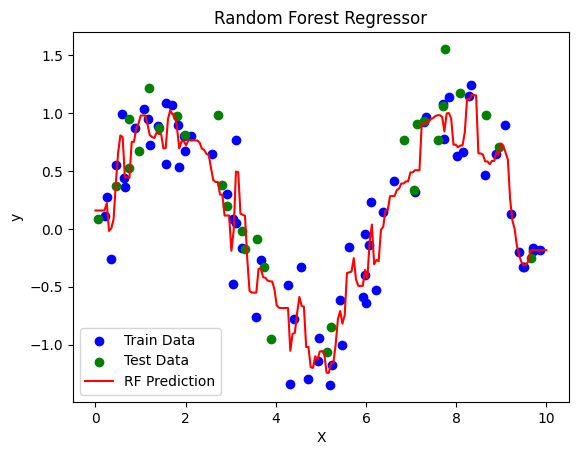
Dataset: \(y = \sin(X) + \text{noise}\) → nonlinear regression example.
Random Forest Regressor:
100 trees (
n_estimators=100)Trains independently on bootstrapped samples
Uses random subset of features at each split (
max_features='auto')oob_score=Truegives an unbiased performance estimate using Out-of-Bag samples.
Metrics:
Train R² → how well model fits training data
Test R² → generalization performance
RMSE → error magnitude
Visualization:
Red curve → Random Forest predictions
Blue/Green points → training/test data
Feature Importance:
Shows which features contributed most to reducing variance (useful if multiple features exist)
Key Takeaways#
Random Forest averages predictions of many trees, reducing variance.
Handles nonlinear relationships naturally.
Out-of-Bag evaluation provides built-in validation.
Hyperparameters like
max_depth,min_samples_leaf, andn_estimatorsare crucial to avoid overfitting or underfitting.