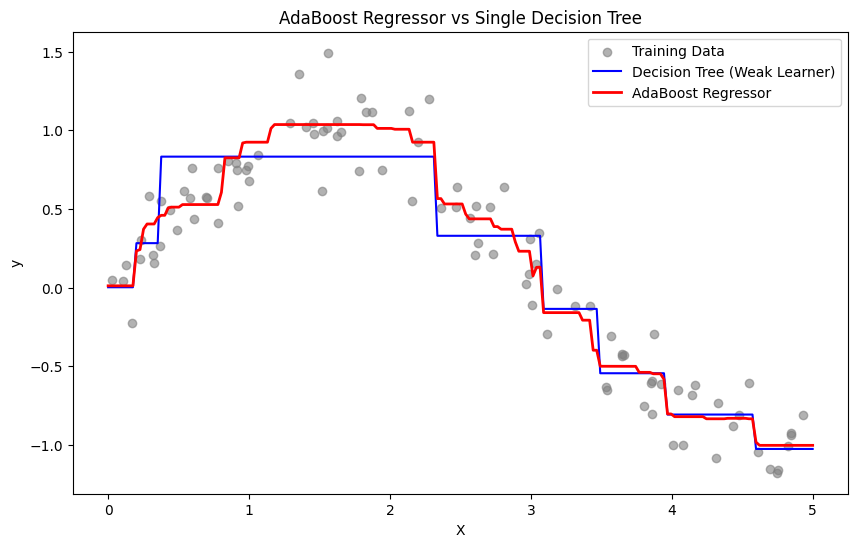

AdaBoost Regressor#
AdaBoost (Adaptive Boosting) is an ensemble method that combines multiple weak regressors (usually shallow decision trees) to build a strong regression model.
Instead of averaging models equally (like Random Forest), AdaBoost assigns different weights to each weak learner, focusing more on points that were harder to predict in previous iterations.
How it Works (Intuition)#
Start with equal weights
Each training sample has the same weight initially.
Train a weak learner (e.g., Decision Tree Regressor of depth=3).
Compute errors
Instead of classification error rate, we use a loss function such as Mean Squared Error (MSE).
Update weights
Data points with higher errors get higher weights.
This forces the next weak learner to focus on the “hard-to-fit” regions of the data.
Combine learners
Each weak regressor gets a weight (
α) based on its performance.The final prediction is a weighted sum of all regressors.
Mathematical Formulation#
For regression, AdaBoost minimizes the exponential loss of residuals:
The final model after \(M\) weak regressors is:
where
\(h_m(x)\) = prediction of weak regressor \(m\),
\(\alpha_m\) = weight of that regressor (higher for more accurate models).
Key Features#
Uses DecisionTreeRegressor (stumps or shallow trees) as default base learners.
Reduces bias (by sequentially correcting errors).
Works well when the data has nonlinear relationships.
Sensitive to outliers (since they get higher weights).
Performance Metrics (Evaluation)#
Same as any regression model:
MSE (Mean Squared Error)
RMSE (Root Mean Squared Error)
MAE (Mean Absolute Error)
R² Score (Explained Variance)
Example (Workflow)#
Input dataset → split into train/test.
Train AdaBoost Regressor with 100 stumps.
At each step → update weights, focus on hard points.
Combine weak regressors into final strong predictor.
Evaluate with MSE, MAE, RMSE, R².
✅ In short: AdaBoost Regressor = many weak regressors (like small trees) + sequential reweighting of difficult points → strong regression model.
import numpy as np
import matplotlib.pyplot as plt
from sklearn.ensemble import AdaBoostRegressor
from sklearn.tree import DecisionTreeRegressor
from sklearn.metrics import mean_squared_error, mean_absolute_error, r2_score

# 1. Generate nonlinear regression dataset (sine wave + noise)
rng = np.random.RandomState(42)
X = np.sort(5 * rng.rand(100, 1), axis=0)
y = np.sin(X).ravel() + rng.normal(0, 0.2, X.shape[0])

# 2. Train weak model (single Decision Tree)
tree_reg = DecisionTreeRegressor(max_depth=3, random_state=42)
tree_reg.fit(X, y)

# 3. Train AdaBoost Regressor (ensemble of trees)
ada_reg = AdaBoostRegressor(
    estimator=DecisionTreeRegressor(max_depth=3),
    n_estimators=50,
    learning_rate=0.5,
    random_state=42
)
ada_reg.fit(X, y)

# 4. Predictions
X_test = np.linspace(0, 5, 200).reshape(-1, 1)
y_tree_pred = tree_reg.predict(X_test)
y_ada_pred = ada_reg.predict(X_test)

# 5. Evaluation metrics
y_pred_train = ada_reg.predict(X)
mse = mean_squared_error(y, y_pred_train)
mae = mean_absolute_error(y, y_pred_train)
r2 = r2_score(y, y_pred_train)

print("📊 AdaBoost Regressor Metrics")
print(f"MSE:  {mse:.3f}")
print(f"MAE:  {mae:.3f}")
print(f"R²:   {r2:.3f}")

# 6. Visualization
plt.figure(figsize=(10,6))
plt.scatter(X, y, c="gray", label="Training Data", alpha=0.6)
plt.plot(X_test, y_tree_pred, color="blue", label="Decision Tree (Weak Learner)")
plt.plot(X_test, y_ada_pred, color="red", linewidth=2, label="AdaBoost Regressor")
plt.legend()
plt.title("AdaBoost Regressor vs Single Decision Tree")
plt.xlabel("X")
plt.ylabel("y")
plt.show()
📊 AdaBoost Regressor Metrics
MSE:  0.026
MAE:  0.131
R²:   0.947