
Cost Function#
HC iteratively merges (agglomerative) or splits (divisive) clusters based on inter-point distances.
The goal is to form clusters such that points in the same cluster are similar and points in different clusters are dissimilar.
The “cost” is implicit: it’s the distance between clusters used in the merge or split decisions.
2. Agglomerative Clustering#
In agglomerative HC, each step merges the two clusters with the smallest distance, according to a linkage criterion.
Common Linkage Criteria#
Linkage |
How Distance is Measured |
“Implicit Cost” |
|---|---|---|
Single |
Minimum distance between points of clusters |
Merge cost = min distance; encourages chaining |
Complete |
Maximum distance between points |
Merge cost = max distance; encourages compact clusters |
Average |
Average distance between all points |
Merge cost = average pairwise distance |
Ward |
Increase in within-cluster variance |
Merge cost = increase in total variance; explicitly tries to minimize it |
Ward linkage is the only one that can be viewed as minimizing an explicit cost function:
Each merge is chosen to minimize the increase in total within-cluster variance.
3. Divisive Clustering#
Divisive HC splits clusters to maximize dissimilarity within sub-clusters or minimize within-cluster variance.
If using K-Means for splits, the cost function is essentially the sum of squared distances to cluster centroids for each split.
Each split is chosen to minimize this cost.
Key Takeaways
HC is distance-driven, not optimization-driven (except Ward linkage).
“Cost” depends on linkage method:
Single → distance between nearest points
Complete → distance between farthest points
Average → average distance
Ward → variance increase (closest to a formal cost function)
Dendrogram height reflects the cost/distance at which clusters were merged or split.
No global objective function exists for general HC; it’s a greedy, hierarchical process.
Intuition
Think of HC as building a tree based on distance costs:
Each merge/split chooses the “cheapest” operation according to the chosen metric.
Ward linkage explicitly tries to minimize total variance, making it the most “cost-function-like” version of HC.
import numpy as np
import matplotlib.pyplot as plt
from sklearn.tree import DecisionTreeRegressor
from sklearn.datasets import make_classification
from sklearn.preprocessing import LabelBinarizer
from scipy.special import expit  # sigmoid
import warnings
warnings.filterwarnings("ignore")

# -------------------------------
# Part 1: Gradient Boosting Regressor (GBR)
# -------------------------------
# Dataset
X_reg = np.linspace(0, 10, 10).reshape(-1,1)
y_reg = np.array([1.5, 1.7, 3.2, 3.9, 5.1, 5.8, 7.0, 7.9, 9.2, 10.1])

# Initialize prediction (F0)
F0 = np.mean(y_reg)
Fm = np.full_like(y_reg, F0, dtype=float)

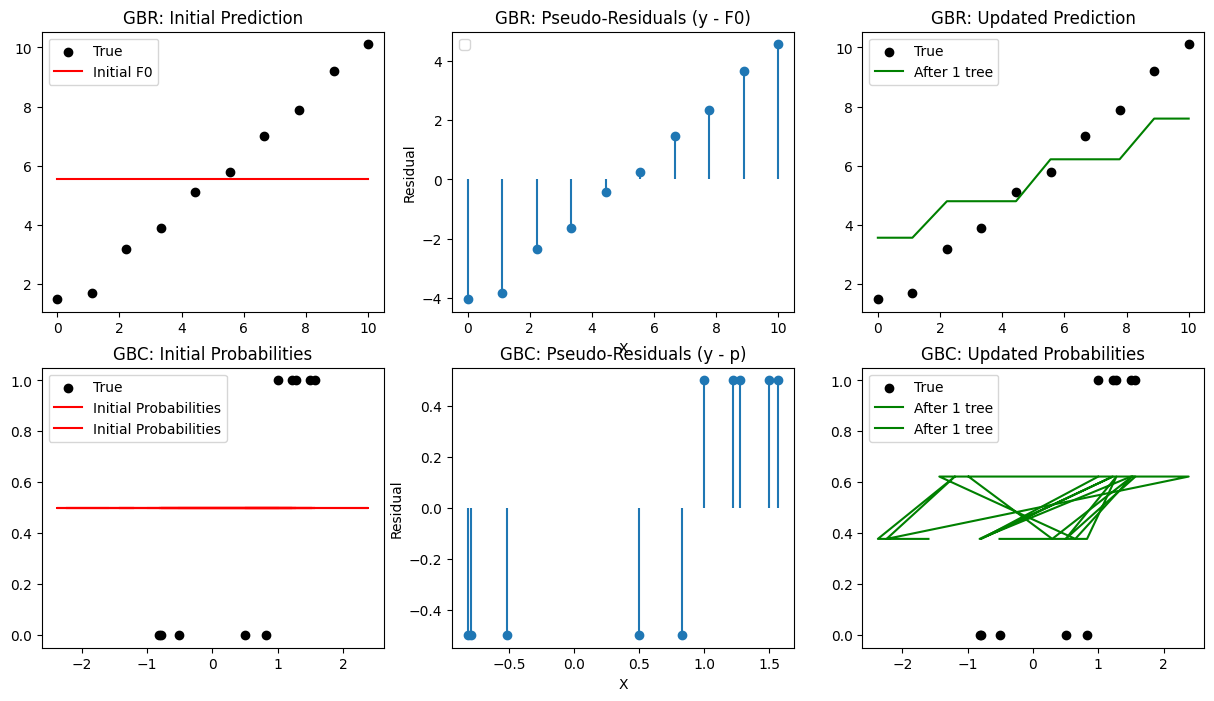
plt.figure(figsize=(15,8))
plt.subplot(2,3,1)
plt.scatter(X_reg, y_reg, color='black', label='True')
plt.plot(X_reg, Fm, color='red', label='Initial F0')
plt.title("GBR: Initial Prediction")
plt.legend()

# Compute pseudo-residuals (MSE)
residuals = y_reg - Fm
plt.subplot(2,3,2)
plt.stem(X_reg, residuals, basefmt=" ")
plt.title("GBR: Pseudo-Residuals (y - F0)")
plt.xlabel("X")
plt.ylabel("Residual")
plt.legend()

# Fit a weak learner
tree = DecisionTreeRegressor(max_depth=2)
tree.fit(X_reg, residuals)
pred = tree.predict(X_reg)
Fm += 0.5 * pred  # learning_rate=0.5

plt.subplot(2,3,3)
plt.scatter(X_reg, y_reg, color='black', label='True')
plt.plot(X_reg, Fm, color='green', label='After 1 tree')
plt.title("GBR: Updated Prediction")
plt.legend()


# -------------------------------
# Part 2: Gradient Boosting Classifier (GBC)
# -------------------------------
# Binary classification dataset
X_clf, y_clf = make_classification(
    n_samples=10,
    n_features=2,      # must be >= log2(n_classes*n_clusters_per_class)
    n_informative=2,
    n_redundant=0,
    n_repeated=0,
    n_classes=2,
    random_state=0
)
y_clf = y_clf.reshape(-1,1)

# Initialize prediction (F0 for log-odds)
p0 = np.mean(y_clf)
F0 = np.log(p0/(1-p0))
Fm = np.full_like(y_clf, F0, dtype=float)

# Compute pseudo-residuals
p = expit(Fm)  # sigmoid probabilities
residuals = y_clf - p


plt.subplot(2,3,4)
plt.scatter(X_clf[:,0], y_clf, color='black', label='True')

plt.plot(X_clf, p, color='red', label='Initial Probabilities')
plt.title("GBC: Initial Probabilities")
plt.legend()

plt.subplot(2,3,5)
plt.stem(X_clf[:,0], residuals, basefmt=" ")
plt.title("GBC: Pseudo-Residuals (y - p)")
plt.xlabel("X")
plt.ylabel("Residual")

# Fit weak learner
tree = DecisionTreeRegressor(max_depth=2)
tree.fit(X_clf, residuals)
pred = tree.predict(X_clf)
Fm = Fm.flatten()       # shape (10,)
pred = pred.flatten()   # shape (10,)
Fm += 0.5 * pred        # works

Fm += 0.5 * pred  # learning_rate=0.5
p = expit(Fm)

plt.subplot(2,3,6)
plt.scatter(X_clf[:,0], y_clf, color='black', label='True')
plt.plot(X_clf, p, color='green', label='After 1 tree')
plt.title("GBC: Updated Probabilities")
plt.legend()
plt.show()