

Hyperparameter Tuning#
Random Forest has several hyperparameters that control the growth of trees, diversity, and ensemble behavior. Tuning these is essential to get the best performance.
Key Hyperparameters#
Hyperparameter |
Description |
Effect / Tuning Tip |
|---|---|---|
|
Number of trees in the forest |
More trees → better performance, lower variance, but slower training. Usually 100–500 is sufficient. |
|
Maximum depth of each tree |
Controls overfitting. Higher depth → complex tree → risk of overfitting. Lower depth → simpler tree → risk of underfitting. |
|
Minimum samples to split a node |
Higher value → simpler tree → reduces overfitting. Lower value → deeper splits → more variance. |
|
Minimum samples at a leaf |
Larger leaf → smoother predictions → reduces overfitting. |
|
Number of features considered at each split |
Lower → more diversity → less correlation among trees → reduces overfitting. Higher → lower bias but more correlated trees. |
|
Whether to use bootstrap sampling |
Usually True (bagging). False → entire dataset per tree → can overfit. |
|
Split quality measure ( |
Affects node splits; usually small impact. |
Hyperparameter Tuning Workflow#
Define Parameter Grid:
param_grid = {
    'n_estimators': [100, 200, 300],
    'max_depth': [None, 5, 10, 15],
    'min_samples_split': [2, 5, 10],
    'min_samples_leaf': [1, 2, 4],
    'max_features': ['sqrt', 'log2', None]
}
Use GridSearchCV or RandomizedSearchCV:
Perform cross-validation to find the combination that maximizes performance on validation sets.
Evaluate Best Model:
Compare train/test R², RMSE (regression) or accuracy, F1-score (classification).
Adjust if Needed:
If overfitting persists, increase
min_samples_leafor reducemax_depth.If underfitting, allow deeper trees or reduce
min_samples_leaf.
2. Handling Overfitting in Random Forest#
Overfitting occurs when the model performs well on training data but poorly on test data. Even though Random Forest reduces overfitting compared to a single tree, it can still overfit if trees are too deep or correlated.
Strategies to Reduce Overfitting#
Limit Tree Depth:
max_depth→ restricts the complexity of each tree.
Increase Minimum Samples per Leaf / Split:
min_samples_leafandmin_samples_split→ prevent trees from fitting noise.
Reduce Maximum Features (
max_features):More randomness → less correlation among trees → better generalization.
Increase Number of Trees (
n_estimators):Averaging predictions over more trees reduces variance.
Use Bootstrapping:
Ensures each tree sees a different dataset → reduces overfitting.
3. Handling Underfitting in Random Forest#
Underfitting occurs when the model is too simple and fails to capture patterns in the data.
Strategies to Reduce Underfitting#
Increase Tree Depth (
max_depth):Allow trees to grow deeper → can capture complex patterns.
Reduce Minimum Samples per Leaf / Split:
Smaller leaves → trees can split more → capture more detail.
Increase Maximum Features (
max_features):Consider more features at each split → less bias.
Increase Number of Trees (
n_estimators):More trees → better aggregation → better capture of patterns.
4. Practical Tips#
Random Forest is robust, but tuning hyperparameters can significantly improve performance.
Use cross-validation to avoid overfitting while tuning.
Monitor train vs test performance:
Large gap → overfitting
Both low → underfitting
Consider feature importance: remove irrelevant features to reduce noise and improve generalization.
5. Visual Intuition#
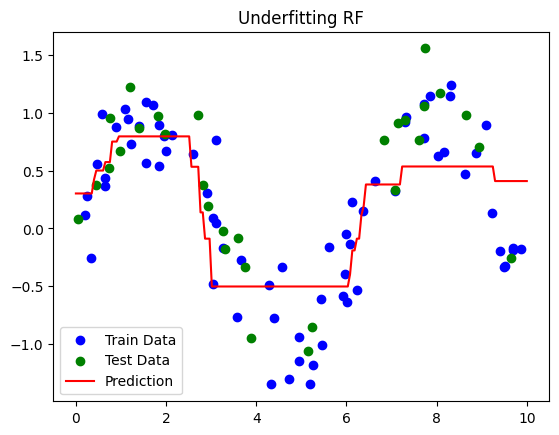
Underfitting: Trees are too shallow, predictions are too flat.
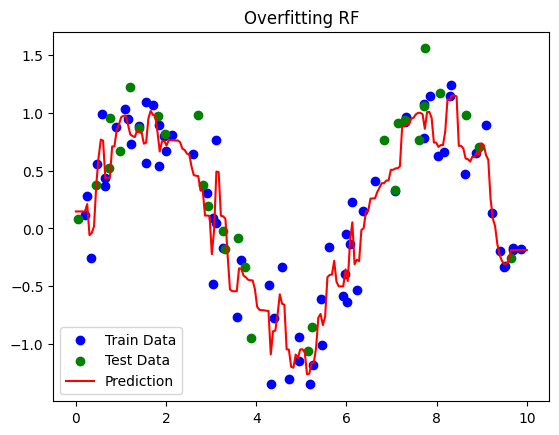
Overfitting: Trees memorize training data, predictions fluctuate on test data.
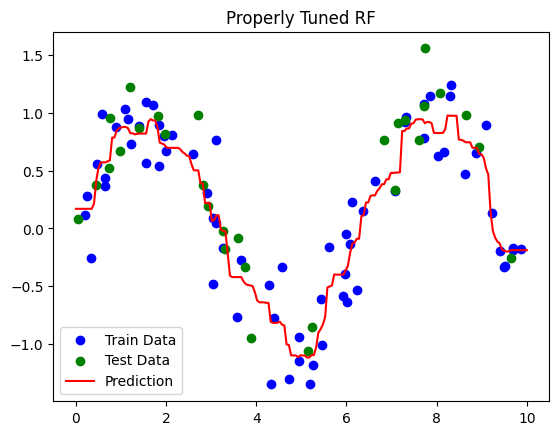
Properly Tuned: Trees are deep enough to capture patterns, but averaging predictions smooths noise → balanced bias and variance.
# Step 1: Import Libraries
import numpy as np
import matplotlib.pyplot as plt
from sklearn.model_selection import train_test_split, GridSearchCV
from sklearn.ensemble import RandomForestRegressor
from sklearn.metrics import r2_score, mean_squared_error

# Step 2: Create Sample Dataset
np.random.seed(42)
X = np.sort(np.random.rand(100, 1) * 10, axis=0)
y = np.sin(X).ravel() + np.random.normal(0, 0.3, X.shape[0])

# Split Dataset
X_train, X_test, y_train, y_test = train_test_split(X, y, test_size=0.3, random_state=42)

# Function to train and evaluate a model
def evaluate_rf(model, X_train, X_test, y_train, y_test, label="Model"):
    model.fit(X_train, y_train)
    y_train_pred = model.predict(X_train)
    y_test_pred = model.predict(X_test)

    print(f"\n{label} Performance:")
    print(f"Train R²: {r2_score(y_train, y_train_pred):.2f}")
    print(f"Test R²: {r2_score(y_test, y_test_pred):.2f}")

    # Plot
    plt.scatter(X_train, y_train, c='blue', label='Train Data')
    plt.scatter(X_test, y_test, c='green', label='Test Data')
    X_plot = np.linspace(0, 10, 200).reshape(-1,1)
    plt.plot(X_plot, model.predict(X_plot), c='red', label='Prediction')
    plt.title(label)
    plt.legend()
    plt.show()

# ----------------------
# Underfitting Example
# ----------------------
rf_underfit = RandomForestRegressor(n_estimators=10, max_depth=2, random_state=42)
evaluate_rf(rf_underfit, X_train, X_test, y_train, y_test, label="Underfitting RF")

# ----------------------
# Overfitting Example
# ----------------------
rf_overfit = RandomForestRegressor(n_estimators=500, max_depth=None, min_samples_leaf=1, random_state=42)
evaluate_rf(rf_overfit, X_train, X_test, y_train, y_test, label="Overfitting RF")

# ----------------------
# Properly Tuned RF using GridSearchCV
# ----------------------
param_grid = {
    'n_estimators': [100, 200],
    'max_depth': [3, 5, 7],
    'min_samples_split': [2, 5],
    'min_samples_leaf': [1, 2]
}

grid_search = GridSearchCV(RandomForestRegressor(random_state=42),
                           param_grid, cv=3, scoring='r2')
grid_search.fit(X_train, y_train)
best_rf = grid_search.best_estimator_
evaluate_rf(best_rf, X_train, X_test, y_train, y_test, label="Properly Tuned RF")
Underfitting RF Performance:
Train R²: 0.63
Test R²: 0.62
Overfitting RF Performance:
Train R²: 0.96
Test R²: 0.79
Properly Tuned RF Performance:
Train R²: 0.90
Test R²: 0.85
Interpretation#
Dataset: \(y = \sin(X) + \text{noise}\) → nonlinear regression pattern.
Underfitting RF:
Very shallow trees (
max_depth=2) and few trees (n_estimators=10) → fails to capture sine pattern.Both train and test R² are low.
Overfitting RF:
Deep trees (
max_depth=None) and many trees → memorizes training data.High train R², test R² may be lower due to noise.
Properly Tuned RF:
GridSearchCV finds optimal depth, number of trees, and leaf size.
Balanced model → captures pattern without overfitting.
Key Takeaways
Underfitting: Increase tree depth, reduce
min_samples_leaf, increasemax_features.Overfitting: Limit tree depth, increase
min_samples_leaf, reducemax_features.Hyperparameter tuning is essential to balance bias and variance in Random Forest.